
Attention is one of the most crucial assets we all have and, just like money, we can spend it the most we choose. Companies have realized our attention has become more valuable than ever and many have developed their business model around the Attention Economy. As Citton (2017) states, “if a product is free, then the real product is you!” I will investigate this claim by exploring my own attention throughout the course of a 12-hour span, including what attracts my attention, distracts me from my task, and why my attention was placed where it was.
What’s Consuming My Attention?
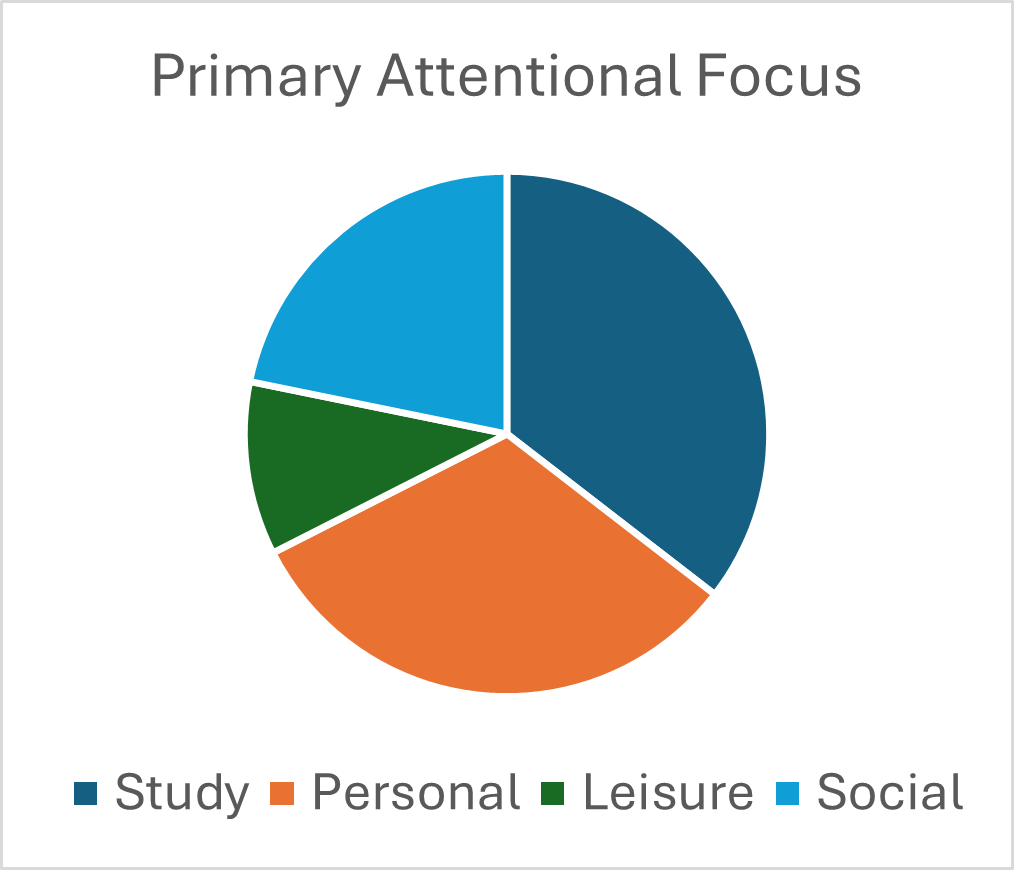
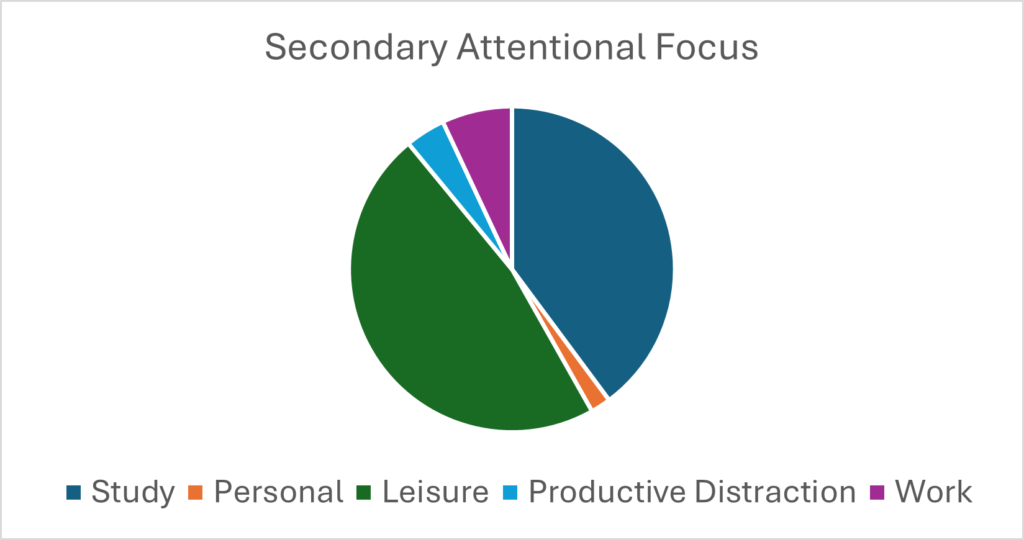
To begin, I split my attention capacity into “Primary” and “Secondary” focuses, along with these categories: study, personal, leisure, social, productive distraction, and work. Overall, primary focus consisted of 12 full hours, and secondary focus (multitasking) occurred for 4.5 hours. I find myself with some characteristics of hyper-attention that Citton (2017) describes, such as “preferring multiple information streams, seeking a high level of stimulation, and having a low tolerance for boredom”. But I can remain focused on something for many hours with minimal distraction, whether it be playing a game, listening to an audiobook, or engaging in a phone call. Something I did notice that distracts me in a moment of concentration is when a specific person (a potential partner) texts me, however others texting me doesn’t distract my attention and this can be put off.
Multitasking is a concern for me as whenever my objective is productivity, studying or working, I always have something going on in the background that could reduce my attention from the task at hand. Sometimes, it will be listening to YouTube while I work, or playing Minecraft as I listen to the course material. Not paying attention to the reading as I should have caused me to have to reread it, when taking notes would have prevented this.
Why Do These Things Grab My Attention?
Why are these things grabbing my attention? To put it bluntly, I am trying to ”maximize rewards”. Green and Bavelier (2012) found that “action video game players seem to maximize reward rate in a variety of tasks” due to “layering of events/actions at many different time scales, resulting in a rather complex pattern of reward in time.” Growing up with these types of videogames seems to account for my capability to complete my goals while multitasking.
Phones, notifications, and algorithms also play a part in what grabs my attention. Although I turn off my notification sound, I do find myself checking my phone to see if I received a message. These companies using algorithms to fight have some success as well, particularly YouTube and Reddit. While they don’t give me notifications, they have somehow managed to grab my subconscious attention, leading me to their app without mindfully choosing to do so. Findings by Šola, Mikac, and Rončević (2022) suggest that just 1.5 seconds spent viewing a Facebook post could influence your emotions, and that often, it is a negative effect. Translating this to my Reddit use makes me realize that reading a headline could have the same effect.
Striving For Attention Online
Something that Citton (2017) has me consider is my own vying for the attention of others through my self-published book company on Amazon. I have to convince people to pay their money to pay attention to the content I produce, and while I don’t spend millions for their attention as Citton states some companies do, I do spend hundreds of dollars each month for their attention. Afef and Jamel-Eddine (2012) concluded that an incidental viewing of an ad leads to higher likelihood of a purchase even if they don’t remember seeing the ad, which along with my ad data, leads me to believe this is a worthwhile investment.
Improving My Attentional Equity
At this time, I am waiting for my new job to begin, so I have more free time than expected in the near future, significantly altering how my focus looks. Major changes will need to occur for high productivity and that begins with reducing secondary leisure time. The connections I have identified show that I intend to multitask with one productive activity and one other activity, with one activity typically being listening. When the listening activity is primary, it still isn’t active listening and the results show.
Having an ability to focus for extended periods is something I can do well, and I know I can improve. Narrowing my focus to a single thing to a single thing seems like a good way to do this, but I do wonder if I had one task to work on without this secondary activity, could it be that my attention is more easily diverted to quick distractions more frequently? Keeping a secondary activity, such as listening to music passively, could be the best solution to keep my attention focused on my work.
References
Citton, Y. (2017). Introduction and conclusion: From attention economy to attention ecology. In Y. Citton, The ecology of attention. John Wiley & Sons.
Green, C. Shawn, & Bavelier, D. (2012). Learning, attentional control, and action video games. Current Biology, 22(6), R197–R206. https://doi.org/10.1016/j.cub.2012.02.012
Šola, H. M., Mikac, M., & Rončević, I. (2022). Tracking unconscious response to visual stimuli to better understand a pattern of human behavior on a Facebook page. Journal of Innovation & Knowledge, 7(1), 100166. https://doi.org/10.1016/j.jik.2022.100166
Afef, A., & Jamel-Eddine, G. (2012). Unconscious processing of incidental advertising: Effects on implicit memory, attitude toward the brand and consideration set. International Journal of Physical and Social Sciences, 2(11), 126–170.
No AI was used in this work